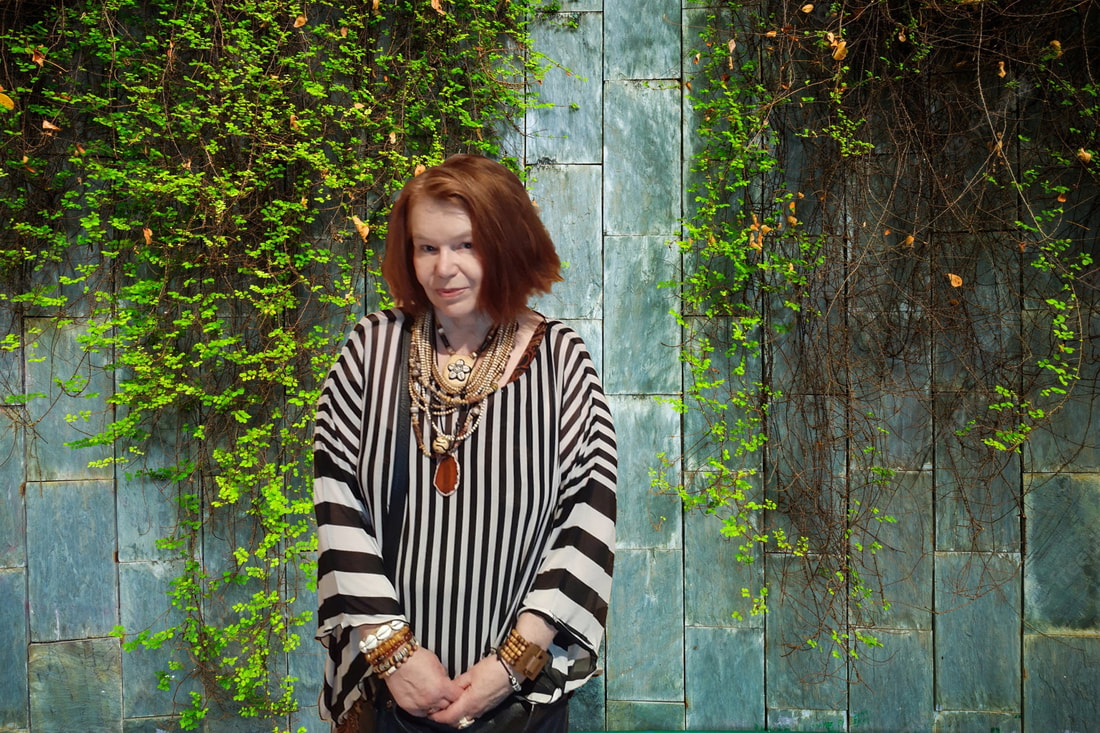
ESSAY BY PEGI EYERS
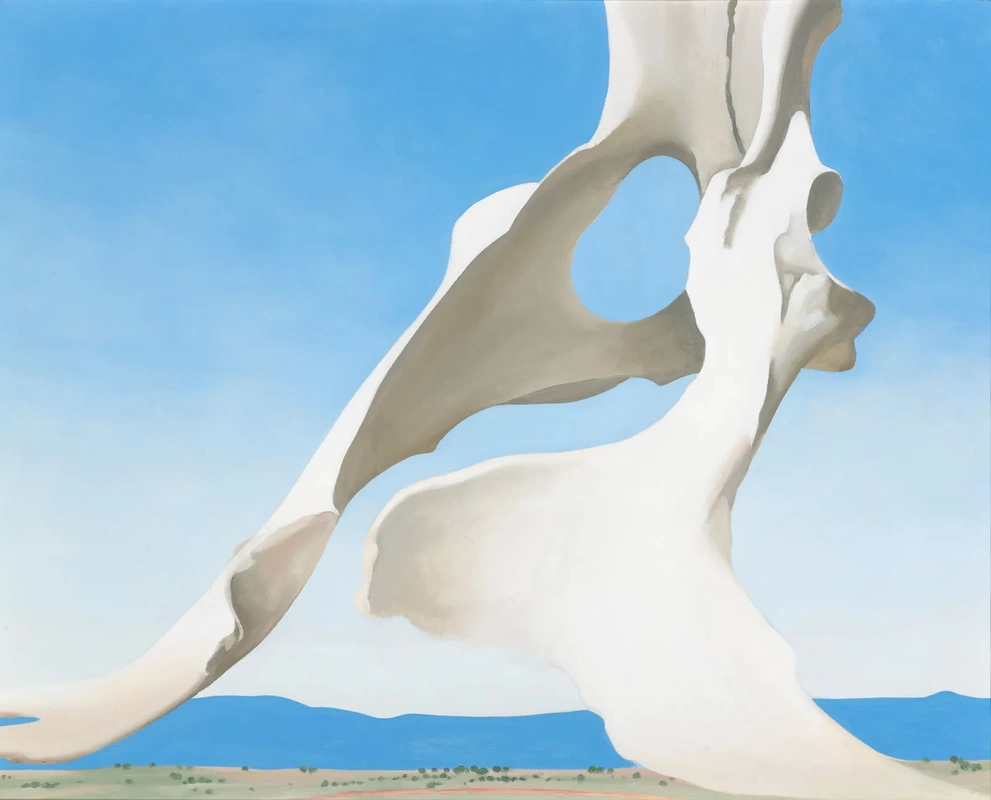
Georgia O'Keefe "Pelvis with the Distance" 1943
When Georgia O'Keefe died in 1986 at the age of ninety-eight, she had become the most revered woman artist in America, and left behind a body of work that was inspired by the land, and forms in wild nature. In her lifetime, a multitude of modern styles in fine art had materialized, such as Impressionism, Symbolism, Post-Impressionism, Fauvism, Expressionism, Cubism, Surrealism, Realism, Hyper-Realism and Conceptualism. But O'Keefe rejected all these in favor of her own direct and simplified, yet powerful studies of mountains, stones, earth, flowers, driftwood, seashells and bones. Her unique personal vision, linked to an absolute love of the Earth, directed her creative explorations in shape, colour, composition and meaning. My own encounter with O’Keefe’s process of interpreting the natural world in bold and unforgettable images, has been an ongoing source of inspiration and deep connection.
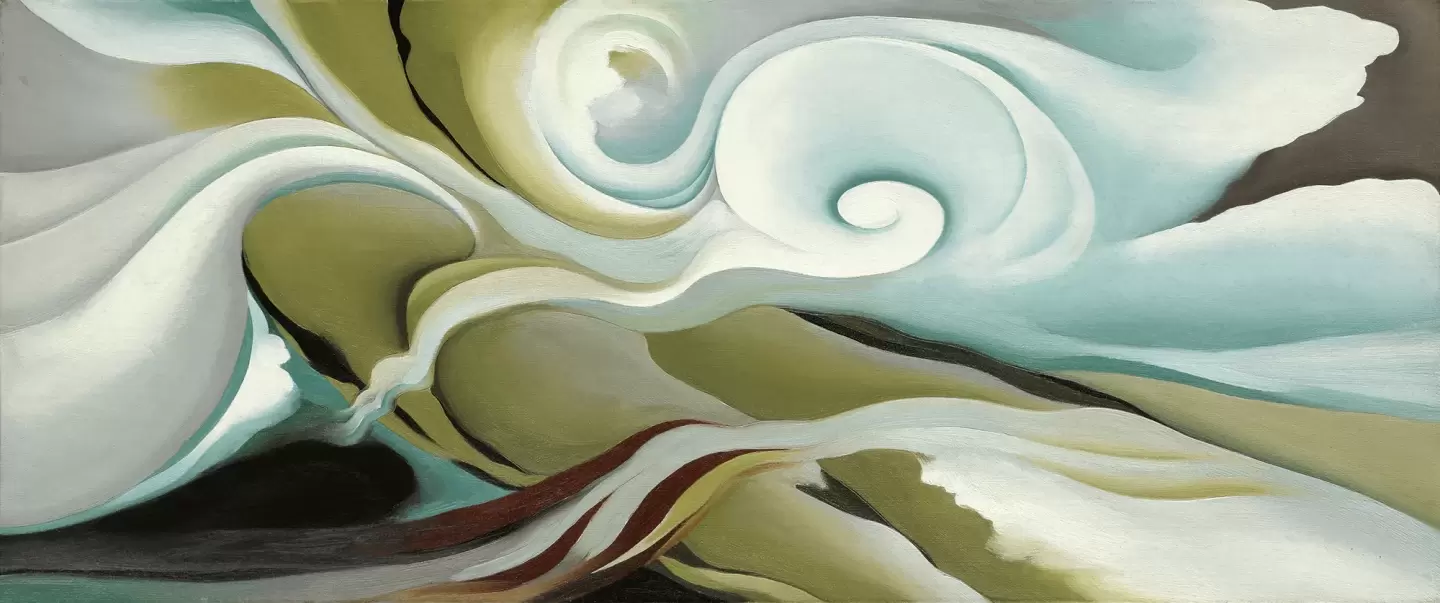
Georgia O'Keefe "Nature Forms - Gaspe" 1932
Seeing Nature’s Beauty
Georgia O’Keefe was born in Wisconsin in 1887, and spent her formative years there and in Virginia, where her family moved when she was fourteen. She had a solitary nature, and according to early biographical accounts, a very precise, unique way of looking at things in her natural environment. She later studied at the School of the Art Institute of Chicago and at the Art Students League of New York. In 1916, while teaching art in Canyon, a small town near Amarillo, Texas, she managed to inspire her students with a passion for beauty, opening their eyes to the natural wonders that thrived in the surrounding prairies. On one occasion she arranged to have a small pony brought into the classroom for the students to draw, much to the consternation of the town officials.
While in Texas, O’Keefe spent many happy hours exploring the wide open spaces of the countryside, wandering through canyons and watching the changing sky. She made charcoal drawings of simple natural shapes and painted experimentally in watercolour, producing a series of variations on the “evening star.” Finished pieces that she sent back to New York were shown to the renowned photographer Alfred Stieglitz, who immediately began to promote and show her work in his influential gallery. A series of yearly exhibitions followed, and O’Keefe’s career as a respected (yet enigmatic) artist was launched.
On a trip to Santa Fe, New Mexico in 1917, O’Keefe marveled at the bright desert light, wide plains, mountains, flat-topped hills, golden mesas and adobe architecture, and vowed to return. As it turned out, the desert terrain of New Mexico was to become her refuge and inspiration in the years to follow. Working in New York, by 1923 O’Keefe had her first solo show featuring paintings of fruit and flowers, and abstractions inspired by the new growth of spring. In 1924, Stieglitz and O’Keefe were married, but Georgia did not share his attraction to the city. Her paintings of the New York skyline were beautiful, yet lacked the warmth and vibrancy of her work that was inspired by natural forms.
Details in nature and inspiration from clouds, hillsides, woods and water, or other elements of the land, continued to be the focus of her fresh and energetic works, as Georgia was able to spend long periods of time away from the city at her summer home in Lake George, New York. She preferred the solitude of being in nature and the process of creative activity to socializing, exhibiting, or selling her work. In 1924, O’Keefe completed the first painting of an ongoing series of giant flowers that filled the canvas, reducing the viewer to the size of a hummingbird. This kind of work had never been seen before - the blossoms were not realistic botanical studies, but an expression of her reverence for flowers.
"I know I cannot paint a flower, but maybe in terms of paint colour I can convey......my experience of the flower or the experience that makes the flower of significance to me at that particular time. When you take a flower in your hand and really look at it, it's your world for that moment. I want to give that world to someone else. Most people in the city rush around so, they have no time to look at a flower. I want them to see it whether they want to or not."[1]
Georgia O’Keefe was born in Wisconsin in 1887, and spent her formative years there and in Virginia, where her family moved when she was fourteen. She had a solitary nature, and according to early biographical accounts, a very precise, unique way of looking at things in her natural environment. She later studied at the School of the Art Institute of Chicago and at the Art Students League of New York. In 1916, while teaching art in Canyon, a small town near Amarillo, Texas, she managed to inspire her students with a passion for beauty, opening their eyes to the natural wonders that thrived in the surrounding prairies. On one occasion she arranged to have a small pony brought into the classroom for the students to draw, much to the consternation of the town officials.
While in Texas, O’Keefe spent many happy hours exploring the wide open spaces of the countryside, wandering through canyons and watching the changing sky. She made charcoal drawings of simple natural shapes and painted experimentally in watercolour, producing a series of variations on the “evening star.” Finished pieces that she sent back to New York were shown to the renowned photographer Alfred Stieglitz, who immediately began to promote and show her work in his influential gallery. A series of yearly exhibitions followed, and O’Keefe’s career as a respected (yet enigmatic) artist was launched.
On a trip to Santa Fe, New Mexico in 1917, O’Keefe marveled at the bright desert light, wide plains, mountains, flat-topped hills, golden mesas and adobe architecture, and vowed to return. As it turned out, the desert terrain of New Mexico was to become her refuge and inspiration in the years to follow. Working in New York, by 1923 O’Keefe had her first solo show featuring paintings of fruit and flowers, and abstractions inspired by the new growth of spring. In 1924, Stieglitz and O’Keefe were married, but Georgia did not share his attraction to the city. Her paintings of the New York skyline were beautiful, yet lacked the warmth and vibrancy of her work that was inspired by natural forms.
Details in nature and inspiration from clouds, hillsides, woods and water, or other elements of the land, continued to be the focus of her fresh and energetic works, as Georgia was able to spend long periods of time away from the city at her summer home in Lake George, New York. She preferred the solitude of being in nature and the process of creative activity to socializing, exhibiting, or selling her work. In 1924, O’Keefe completed the first painting of an ongoing series of giant flowers that filled the canvas, reducing the viewer to the size of a hummingbird. This kind of work had never been seen before - the blossoms were not realistic botanical studies, but an expression of her reverence for flowers.
"I know I cannot paint a flower, but maybe in terms of paint colour I can convey......my experience of the flower or the experience that makes the flower of significance to me at that particular time. When you take a flower in your hand and really look at it, it's your world for that moment. I want to give that world to someone else. Most people in the city rush around so, they have no time to look at a flower. I want them to see it whether they want to or not."[1]
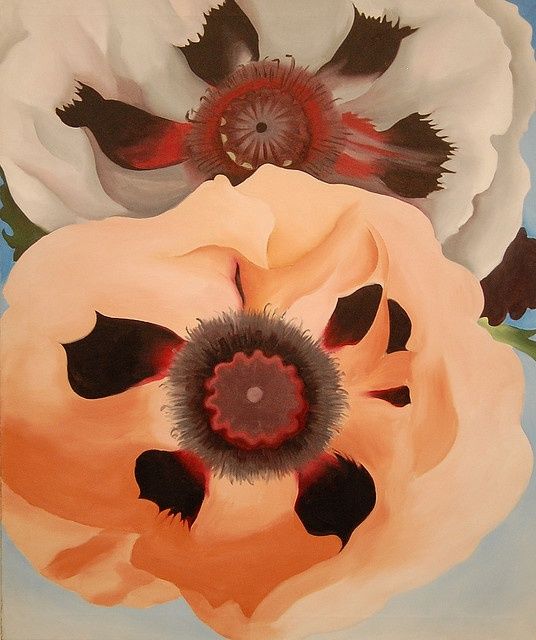
Georgia O'Keefe "Poppies" 1950
Abstracting Natural Forms
Georgia O’Keefe carefully observed the shapes found in nature, and translated them into very personal, instinctual abstractions. “The abstraction is often the most definite form for the intangible thing in myself that I can only clarify in paint."[2]
Instead of the traditional academic method of representational painting, O’Keefe added freely-drawn or painted space, shape, line, colour and pattern to realistic detailing. "If one can only reproduce nature, and always with less beauty than the original, why paint at all?"[3]
She tried to emphasize a depth of emotion in her art, and worked toward rhythm and compositional balance. O'Keefe's choice of subject matter expressed her empathy with natural forms connected to the cycles of life - shells, feathers, bones, stones, trees, hills, clouds, and the sky. Arrangements of landscape, fruit, flowers, plants, leaves, still life or architectural elements were painted clearly, simply and peacefully, achieving a grandeur and powerful immediacy. These natural forms were self-contained, elementary and timeless.
Georgia O’Keefe carefully observed the shapes found in nature, and translated them into very personal, instinctual abstractions. “The abstraction is often the most definite form for the intangible thing in myself that I can only clarify in paint."[2]
Instead of the traditional academic method of representational painting, O’Keefe added freely-drawn or painted space, shape, line, colour and pattern to realistic detailing. "If one can only reproduce nature, and always with less beauty than the original, why paint at all?"[3]
She tried to emphasize a depth of emotion in her art, and worked toward rhythm and compositional balance. O'Keefe's choice of subject matter expressed her empathy with natural forms connected to the cycles of life - shells, feathers, bones, stones, trees, hills, clouds, and the sky. Arrangements of landscape, fruit, flowers, plants, leaves, still life or architectural elements were painted clearly, simply and peacefully, achieving a grandeur and powerful immediacy. These natural forms were self-contained, elementary and timeless.
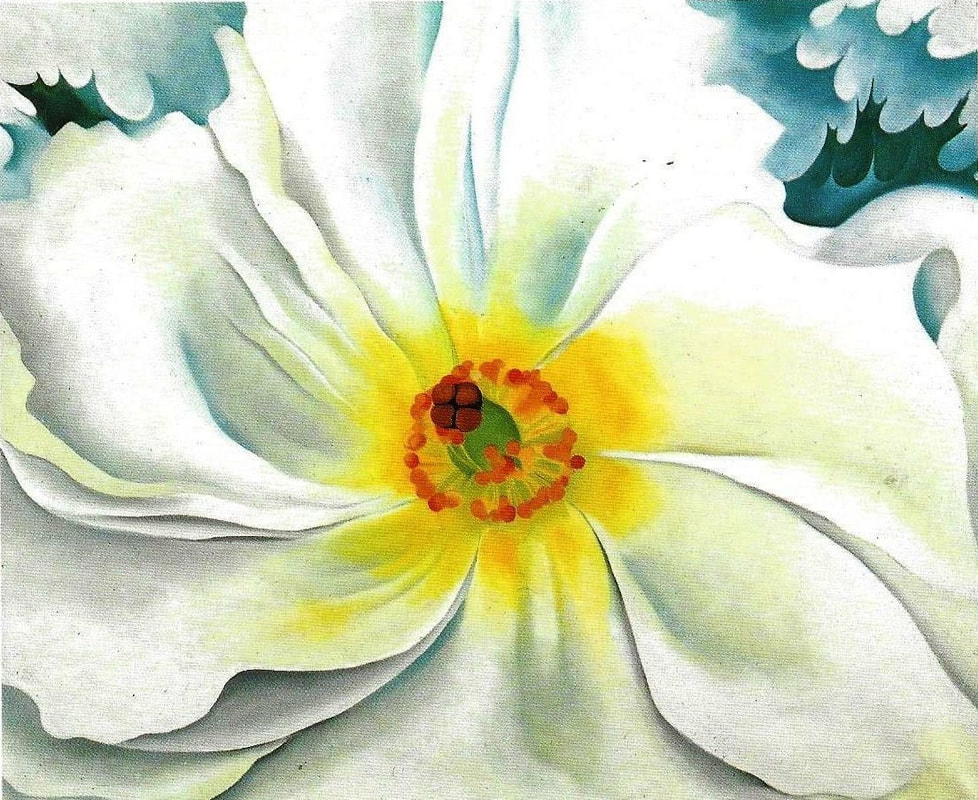
Georgia O'Keefe "White Flower" 1929
Solitude in the Desert
By 1929, Georgia O'Keefe was in need of fresh inspiration for her work, and determined to express her independent spirit, left for Santa Fe. She yearned to paint the western scenes she had missed since moving to New York, and immediately discovered that New Mexico "woke up her soul." She loved exploring the wild, unspoiled terrain, finding pleasure in the silver-grey sagebrush, the purple mountains, and the vast expanse of desert.
The pure, radiant sunshine and the thin, dry air enabled her to see for miles in all directions, and made everything she looked at perfectly simple and clear. In the desert, she found dry, bleached animal skulls and bones that prompted her imagination, and much to the shock of the art establishment, created a series of detailed, surreal, evocative works. The desert ecosystem entranced her, and she discovered that the visual contrast between flowers and bones was beautiful and mysterious.
"When I found the beautiful white bones in the desert I picked them up and took them home. I have used these things to say what is to me, the wideness and wonder of the world as I live in it. The bones seem to cut sharply to the center of something that is keenly alive."[4]
She used the bleached pelvic bone of a cow in a number of paintings, capturing it in extreme close-ups, or setting it floating above the mountains with the moon shining through. Her paintings at this time were described by a critic as "ripe with beauty, touched by grace, and buoyant with vision."
O'Keefe eventually bought an adobe house at Ghost Ranch, in her favorite territory near Abiquiu, New Mexico. She explored, collected natural artifacts from the desert (stones, branches, bones), and tried to capture the colour and texture of the nearby hills and cliffs on canvas. For many years, and permanently after the death of Stieglitz, O'Keefe was content to be alone in the desert wilderness she loved. She seemed to need very few people, as she had her house, her mountains and her art. However far she travelled in her later years, her deep connection to the desert - a kind of spiritual compass - led her back to Abiquiu.
By 1929, Georgia O'Keefe was in need of fresh inspiration for her work, and determined to express her independent spirit, left for Santa Fe. She yearned to paint the western scenes she had missed since moving to New York, and immediately discovered that New Mexico "woke up her soul." She loved exploring the wild, unspoiled terrain, finding pleasure in the silver-grey sagebrush, the purple mountains, and the vast expanse of desert.
The pure, radiant sunshine and the thin, dry air enabled her to see for miles in all directions, and made everything she looked at perfectly simple and clear. In the desert, she found dry, bleached animal skulls and bones that prompted her imagination, and much to the shock of the art establishment, created a series of detailed, surreal, evocative works. The desert ecosystem entranced her, and she discovered that the visual contrast between flowers and bones was beautiful and mysterious.
"When I found the beautiful white bones in the desert I picked them up and took them home. I have used these things to say what is to me, the wideness and wonder of the world as I live in it. The bones seem to cut sharply to the center of something that is keenly alive."[4]
She used the bleached pelvic bone of a cow in a number of paintings, capturing it in extreme close-ups, or setting it floating above the mountains with the moon shining through. Her paintings at this time were described by a critic as "ripe with beauty, touched by grace, and buoyant with vision."
O'Keefe eventually bought an adobe house at Ghost Ranch, in her favorite territory near Abiquiu, New Mexico. She explored, collected natural artifacts from the desert (stones, branches, bones), and tried to capture the colour and texture of the nearby hills and cliffs on canvas. For many years, and permanently after the death of Stieglitz, O'Keefe was content to be alone in the desert wilderness she loved. She seemed to need very few people, as she had her house, her mountains and her art. However far she travelled in her later years, her deep connection to the desert - a kind of spiritual compass - led her back to Abiquiu.
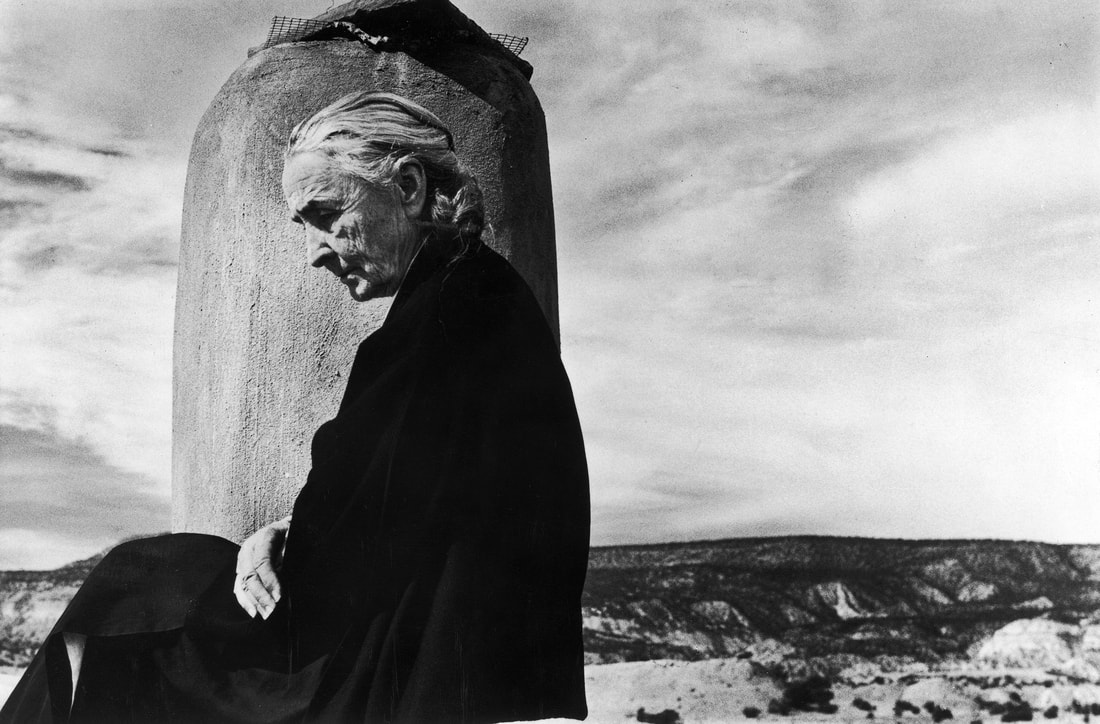
Georgia O'Keefe at Ghost Ranch, John Loengard, The LIFE Picture Collection, 1968
The Georgia O'Keefe Aesthetic
Every phase of O'Keefe's work is unique, from her early charcoal drawings and abstractions to her flower and bone series, and all are personal expressions based on a fascination with shape and natural form. She was not influenced by any other artist or style, and was the first entirely self-motivated artist in America. When O’Keefe looked deeply into the earth and sky, and translated their elements into lyrical forms, she found deep meaning in nature and in herself. O’Keefe has been called a mystic, as her work is infused with a cosmic spirit, both in the immediacy of nature, and how organic objects are held within containers and boundaries.
She was aware of the tree as a universal symbol of immortality, and the mystical and spiritual meaning of deep-rooted beings extending their branches to heaven. Her paintings of trees express this and more, as the soft focus of the upward-curving limbs hint at an other-worldly dimension. Her powerful, radiant flowers, vibrant and alive, and bold vistas of ancient landscapes affirm all that is sacred in creation. Each painting is a meditation on nature, and the compelling aesthetic of simplicity and peace. The concept of "less is more" is an apt description, for both Georgia O’Keefe’s art and her life.
Every phase of O'Keefe's work is unique, from her early charcoal drawings and abstractions to her flower and bone series, and all are personal expressions based on a fascination with shape and natural form. She was not influenced by any other artist or style, and was the first entirely self-motivated artist in America. When O’Keefe looked deeply into the earth and sky, and translated their elements into lyrical forms, she found deep meaning in nature and in herself. O’Keefe has been called a mystic, as her work is infused with a cosmic spirit, both in the immediacy of nature, and how organic objects are held within containers and boundaries.
She was aware of the tree as a universal symbol of immortality, and the mystical and spiritual meaning of deep-rooted beings extending their branches to heaven. Her paintings of trees express this and more, as the soft focus of the upward-curving limbs hint at an other-worldly dimension. Her powerful, radiant flowers, vibrant and alive, and bold vistas of ancient landscapes affirm all that is sacred in creation. Each painting is a meditation on nature, and the compelling aesthetic of simplicity and peace. The concept of "less is more" is an apt description, for both Georgia O’Keefe’s art and her life.
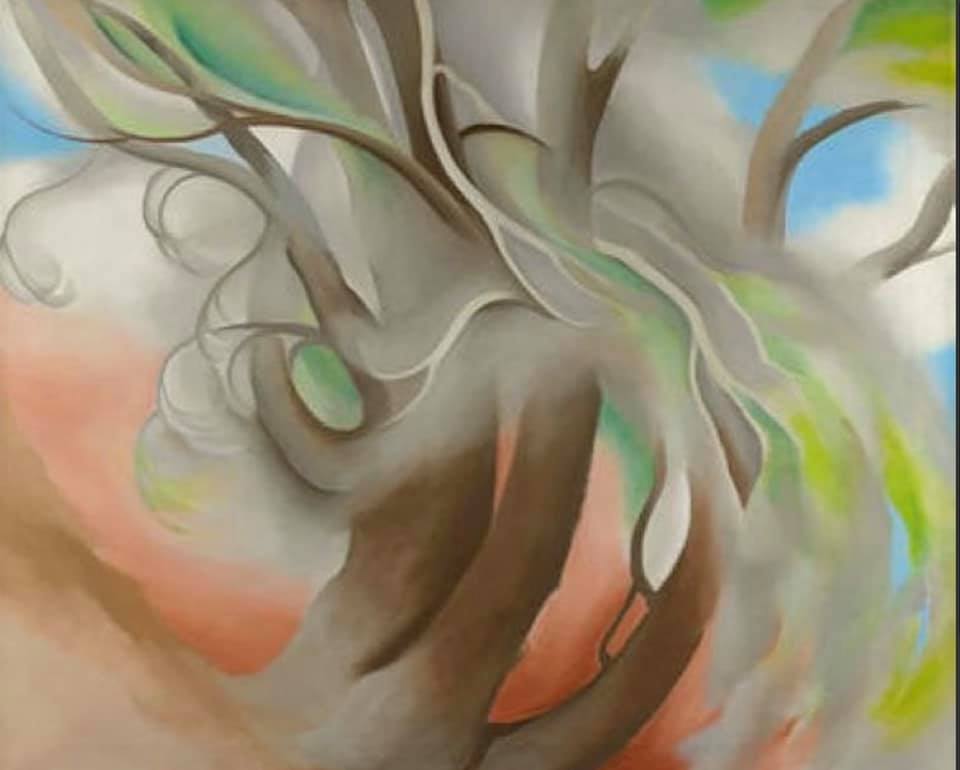 Georgia O'Keefe "Spring Tree No II" 1945 | 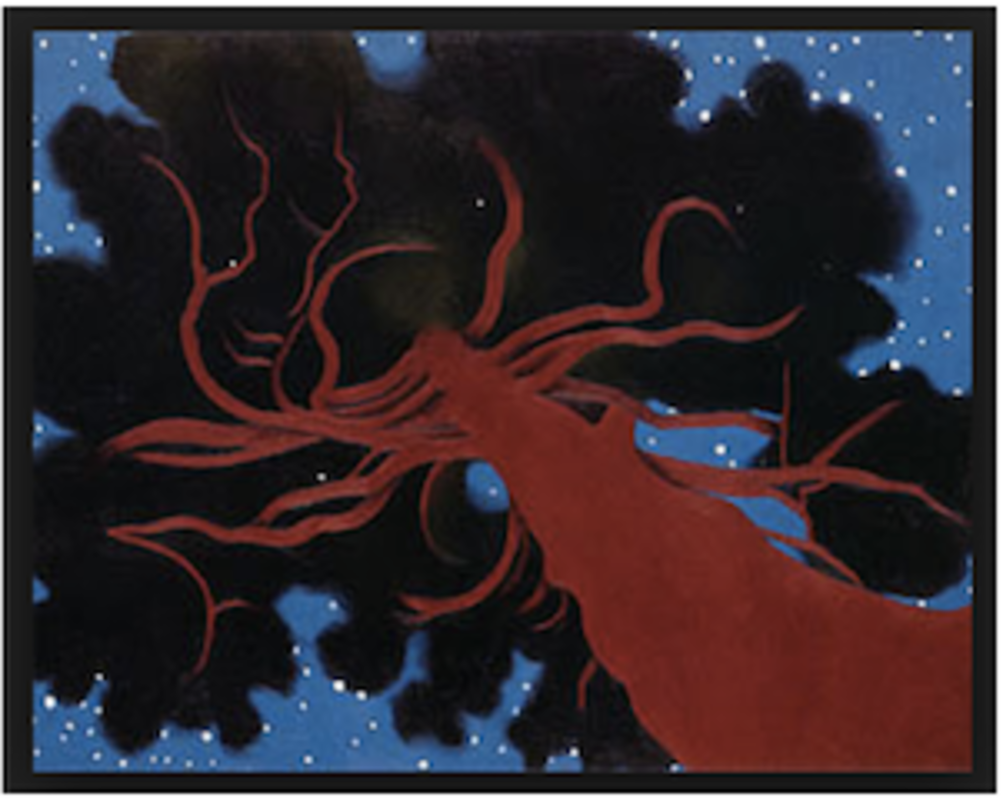 Georgia O'Keeffe "The Lawrence Tree" 1929 |
Revised Essay by Pegi Eyers
Nature: Art, Myth and Folklore
University of Waterloo Course with Sehdev Kumar, 1995
NOTES
[1] Michael Berry, Georgia O'Keefe, Chelsea House, New York, 1988; and
Georgia O’Keefe, Georgia O'Keefe, Viking, New York, 1976
[2] Georgia O’Keefe, Georgia O'Keefe, Viking, New York, 1976
[3] Michael Berry, Georgia O'Keefe, Chelsea House, New York, 1988
[4] Michael Berry, Georgia O'Keefe, Chelsea House, New York, 1988; and
Georgia O’Keefe, Georgia O'Keefe, Viking, New York, 1976
BIBLIOGRAPHY
[1] Michael Berry, Georgia O'Keefe, Chelsea House, New York, 1988; and
Georgia O’Keefe, Georgia O'Keefe, Viking, New York, 1976
[2] Georgia O’Keefe, Georgia O'Keefe, Viking, New York, 1976
[3] Michael Berry, Georgia O'Keefe, Chelsea House, New York, 1988
[4] Michael Berry, Georgia O'Keefe, Chelsea House, New York, 1988; and
Georgia O’Keefe, Georgia O'Keefe, Viking, New York, 1976
BIBLIOGRAPHY
- Elmo Baca and Suzanne Deats, Santa Fe Design, Publications International Ltd., 1990
- Michael Berry, Georgia O'Keefe, Chelsea House, 1988
- Megan Bice and Sharyn Udall, The Informing Spirit: Art of the American Southwest and West Coast Canada 1925 -1945, McMichael Canadian Art Collection, 1994
- Jan Garden Castro, The Art & Life of Georgia O’Keefe, Crown Publishers, 1985
- Frederick Hartt, Art: A History of Painting, Sculpture and Architecture, Harry Abrams, 1989
- Laurie Lisle, Portrait of an Artist: A Biography of Georgia O’Keefe, Washington Square Press, 1980
- Georgia O’Keefe, Georgia O'Keefe, Viking, 1976
FURTHER READING
The Georgia O'Keefe Museum
Georgia O'Keefe, On the Ghost Ranch
Georgia O'Keefe, a Force of Nature
Georgia O'Keefe and Friends
Official Georgia O'Keefe Group on Facebook
Adobe, Sky and Bones at Georgia O'Keefe's Abiquiu Home
The Georgia O'Keefe Museum
Georgia O'Keefe, On the Ghost Ranch
Georgia O'Keefe, a Force of Nature
Georgia O'Keefe and Friends
Official Georgia O'Keefe Group on Facebook
Adobe, Sky and Bones at Georgia O'Keefe's Abiquiu Home

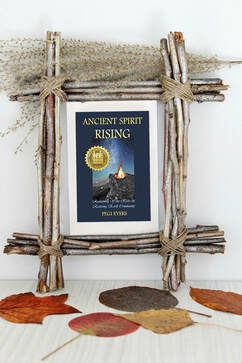
Pegi Eyers is the author of "Ancient Spirit Rising:
Reclaiming Your Roots & Restoring Earth Community"
an award-winning book that explores strategies for intercultural
competency, healing our relationships with Turtle Island First Nations, uncolonization, recovering an ecocentric worldview, rewilding, creating a sustainable future and reclaiming peaceful co-existence in Earth Community.
Available from Stone Circle Press or Amazon.
Reclaiming Your Roots & Restoring Earth Community"
an award-winning book that explores strategies for intercultural
competency, healing our relationships with Turtle Island First Nations, uncolonization, recovering an ecocentric worldview, rewilding, creating a sustainable future and reclaiming peaceful co-existence in Earth Community.
Available from Stone Circle Press or Amazon.